

About syncplexity
Practical competitiveness architecture under hypercompetitive conditions.
syncplexity was created in response to the growing difficulties many organizations face in sustaining competitiveness, profitability, differentiation, and operational coherence under increasingly hypercompetitive market conditions.
Ecosystem structure
The competitiveness architecture and conceptual foundation.
The Competitive Architecture methodology.
The institutional platform for dissemination and capability transfer.
Its foundations evolved through direct involvement in organizations operating under severe competitive pressure, where conventional approaches frequently proved insufficient to sustain long-term competitiveness and adaptive resilience.
Part of the professional trajectory behind these observations can be explored through The Journey.
Foundations developed through practical application across demanding competitive environments.
The practical evolution of Competitive Architecture.
The strong results achieved under highly demanding competitive conditions revealed the existence of structural competitiveness dynamics that conventional approaches frequently failed to address effectively.
These interventions demonstrated that, even under severe resource limitations and intense competitive pressure, organizations could significantly strengthen their competitiveness when strategic coherence, authentic behaviour, organizational energy, and execution dynamics were aligned coherently.
These observations motivated the development of a methodology capable of reproducing similar transformation dynamics across different competitive environments, sectors, organizational structures, and geographical contexts.
This process gave rise to Competitive Architecture.
Over time, the methodology continued evolving through direct practical application across multiple hypercompetitive scenarios, consistently demonstrating its capacity to reinforce competitiveness, adaptability, execution consistency, and sustainable profitability under increasingly demanding market conditions.
The role of coherence and organizational energy under hypercompetitive conditions.
The initial development of Competitive Architecture emerged under conditions where the need to generate competitive advantage significantly exceeded the resources available to achieve it through conventional means.
In many cases, organizations lacked the capacity to incorporate highly specialized structures, implement sophisticated systems, or sustain large-scale communication and advertising efforts capable of generating sufficient differentiation under increasingly demanding competitive environments.
Under severe competitive constraints, the exploration of internally generated structural advantages became central to the methodology’s evolution.
This reality led to the exploration of alternative competitiveness drivers capable of strengthening organizational performance through internally generated structural advantages.
The initial approach — continuously refined through practical application — focused primarily on maximizing two interconnected elements: coherence and the development of organizational energy across four fundamental dimensions: generation, shaping, driving, and coherent channelling.
Competitive Architecture methodology.
The structural model connects dynamic energy, competitiveness factors, evaluation criteria, and execution capabilities within a coherent architecture.
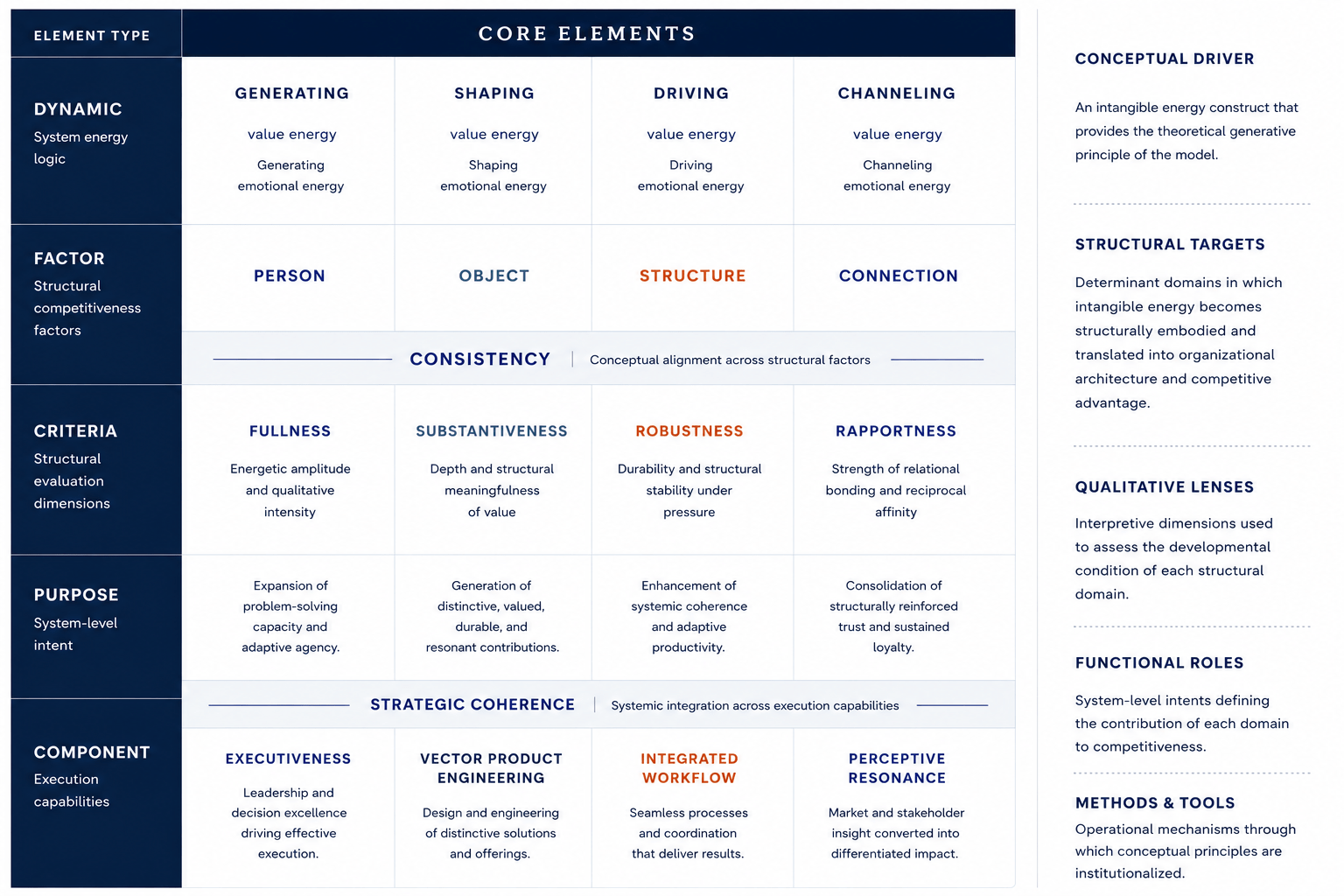
Coherent execution through integrated dynamics: when the elements operate in alignment, competitiveness is strengthened, differentiation is sustained, and long-term value can be consistently created.
Competitiveness deterioration is often reversible.
As these dynamics were explored in greater depth, repeated interventions revealed that many forms of competitiveness deterioration were not only extensive, but also structurally reversible.
These observations demonstrated that organizations could significantly reinforce competitiveness, adaptability, responsiveness, and resilience even under severe constraints, provided sufficient commitment existed to evolve coherently at strategic, operational, and behavioural levels.
At the same time, practical experience revealed that sustainable transformation cannot be artificially simulated. Under hypercompetitive conditions, incoherent behaviours, defensive executive dynamics, artificial positivity, and fragmented organizational energy weaken trust, responsiveness, execution quality, and long-term competitiveness.
Conversely, coherent and authentically aligned transformation reinforces organizational credibility, perceptive solidity, adaptive responsiveness, execution consistency, and sustainable competitive strength.
Under this logic, Competitive Architecture approaches competitiveness not merely as a strategic or operational phenomenon, but as the integrated alignment of organizational structure, authentic behaviour, execution dynamics, and organizational energy under real market conditions.
The creation of SPX Prestige School.
As Competitive Architecture continued evolving through direct practical application across increasingly demanding competitive environments, the need emerged to create a structured institutional platform capable of disseminating these transformation principles beyond isolated interventions.
This process gave rise to SPX Prestige School, the institutional dissemination structure of the syncplexity ecosystem.
SPX Prestige School was created with the purpose of making coherent competitiveness transformation accessible to organizations operating under real market pressure, particularly retail businesses and small and medium-sized enterprises facing increasingly hypercompetitive conditions.
Its purpose is not merely educational.
It exists to provide organizations with a realistic, practical, and experience-based alternative capable of helping them strengthen competitiveness, adaptability, profitability, execution consistency, and long-term sustainability under conditions where many organizations assume that viable alternatives no longer exist.
Structured dissemination of transformation principles.
Transfer of transformation capacities.
Support for coherent competitiveness under real operational conditions.
Capability development connected to execution dynamics over time.
Competitiveness as an organizational capacity.
Under this logic, competitiveness is approached not as an isolated technical discipline, but as an integrated organizational capacity requiring coherent execution, authentic behaviour, adaptability, organizational solidity, and sustainable execution dynamics over time.
Related ecosystem components
The Competitive Architecture methodology and SPX Prestige School provide the complementary methodological and institutional components of the syncplexity ecosystem.